







The Cyan Sea preserves its own memory in stone. What appears today as a tranquil scatter of tropical archipelagos is, in fact, the exposed crown of a far older continental structure — fractured, drowned, and reborn across successive geological epochs. The formation known collectively as Elder Cyana, Old Cyana, and New Cyana represents not three separate island chains, but three visible phases of a single tectonic organism slowly sinking into the sea.
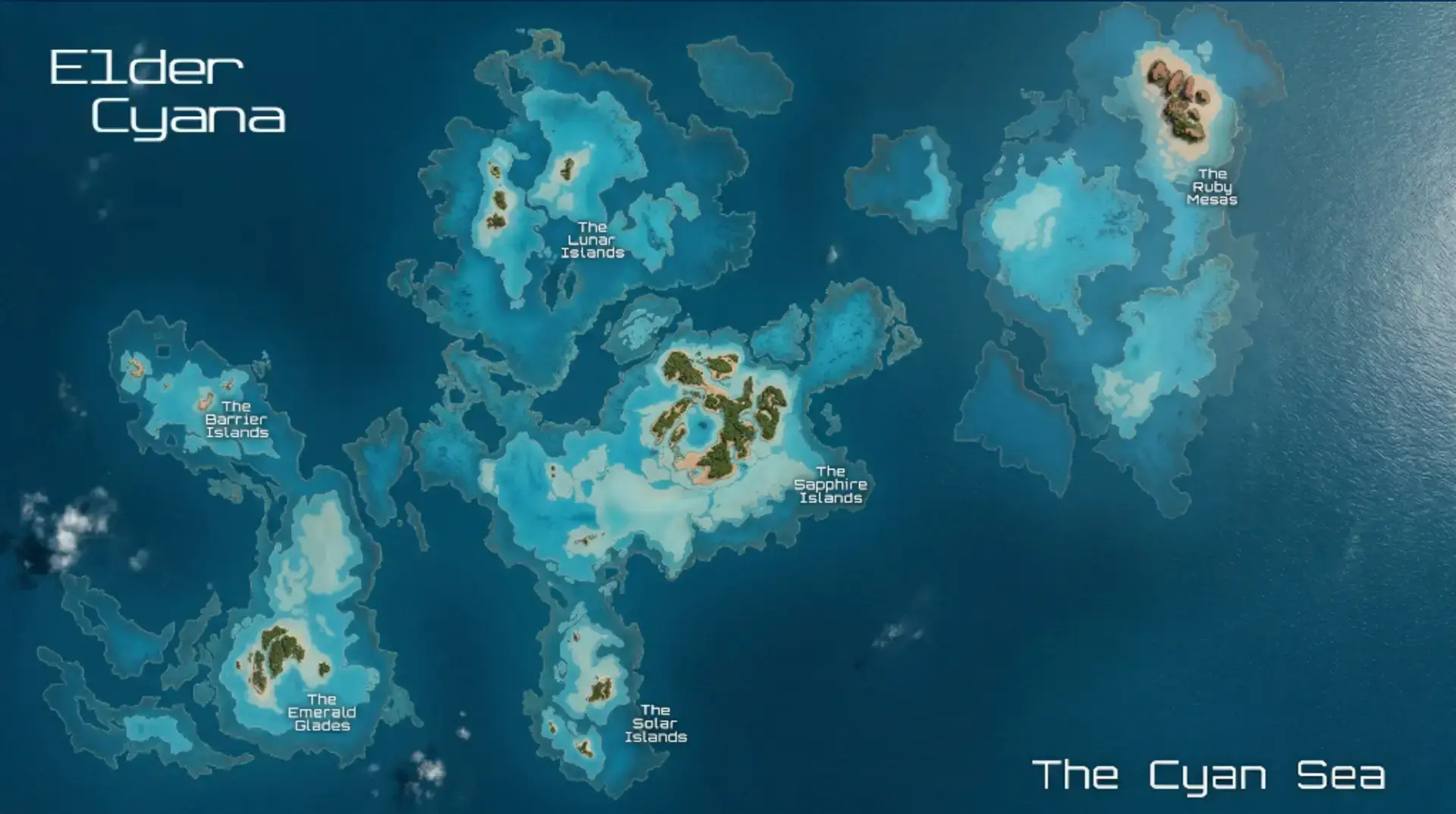
These regions would have been above sea level.
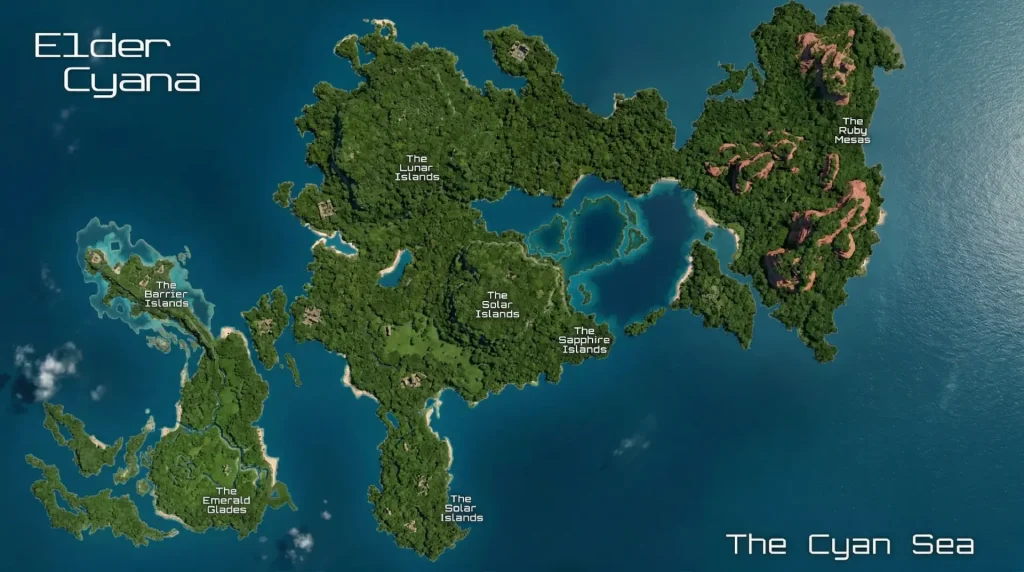
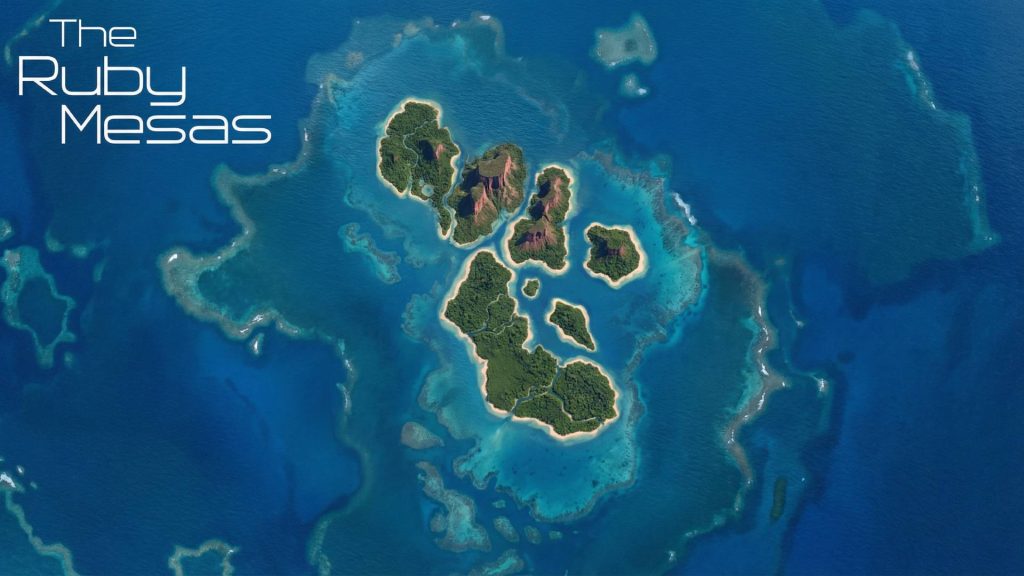
Elder Cyana is the oldest stratum — a massive uplifted formation whose outline remains faintly visible in bathymetric surveys beneath the eastern quadrant of the Cyan Sea. Satellite imaging shows collapsed calderas, submerged plate shelves, and radial fracture lines indicating catastrophic seismic destabilization in antiquity. What remains above water today — the Ruby mesas and their surrounding reefs — are merely the hardened ridgelines of what was once a dominant landmass. Elder Cyana was not eroded into nothing; it subsided.
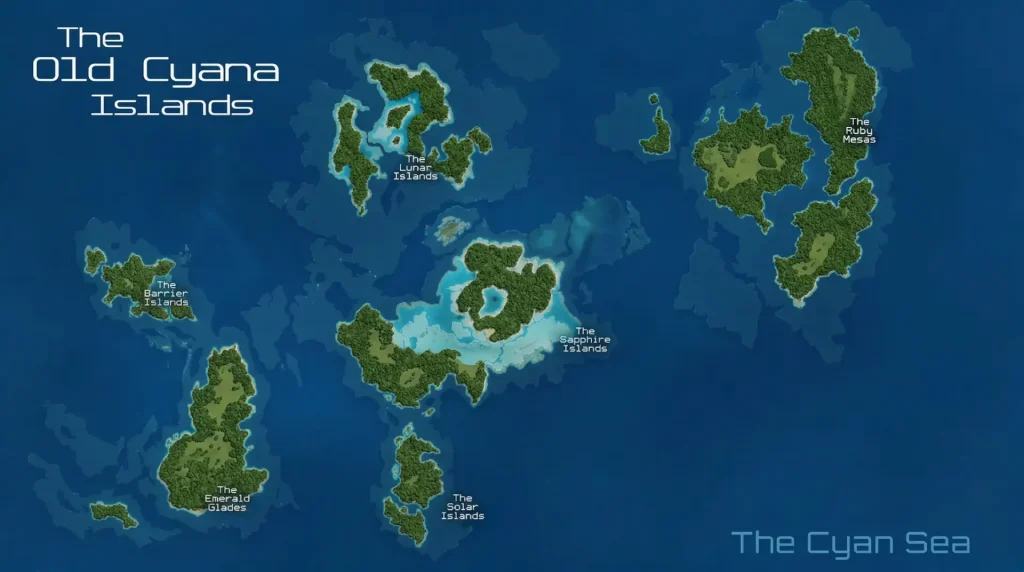
Old Cyana formed along the stabilized western plate margin following that collapse. It represents the second flowering — a broader, more temperate spread of islands and shallow basins. The Lunar Islands and the Barrier Islands occupy portions of this middle epoch. Geological cores show layered sediment deposition consistent with long habitation cycles, interrupted by ash signatures from volcanic activity inherited from Elder Cyana’s destabilization. Old Cyana was less mountainous, more navigable, and likely more politically centralized in its peak era. Its decline appears gradual rather than catastrophic — shoreline retreat, rising seas, and slow fragmentation rather than sudden annihilation.
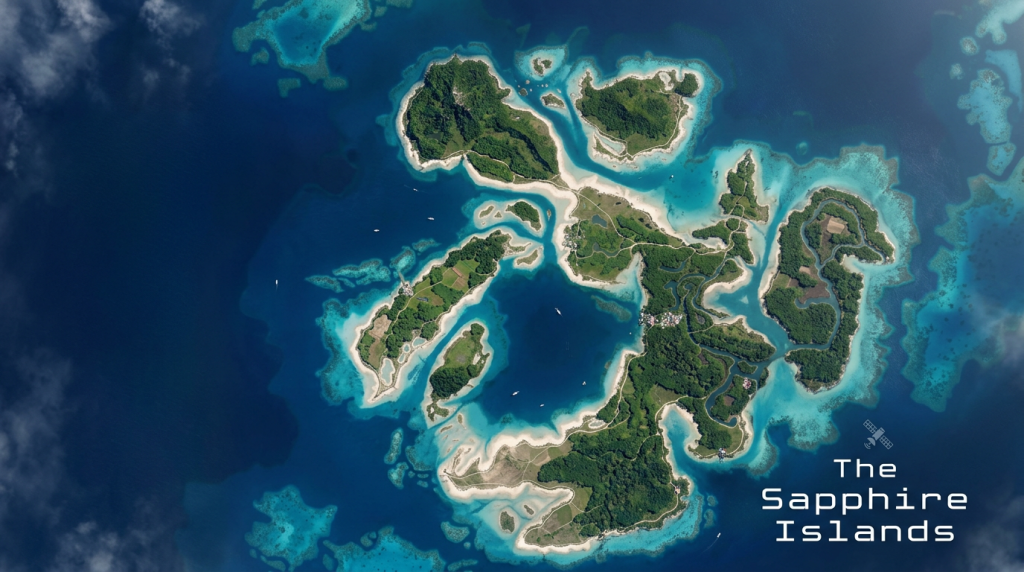
New Cyana is the surviving apex — the central Sapphire Islands and their surrounding satellite chains. What remains today is the tectonic high point of the entire formation, stabilized by the residual mantle uplift that once supported its predecessors. It is smaller in landmass than either Elder or Old Cyana at their peaks, yet more structurally secure. Coral development is dense. Reef walls form natural breakwaters. Lagoons remain unusually clear due to convergent current shielding created by the drowned shelves of its ancestors.
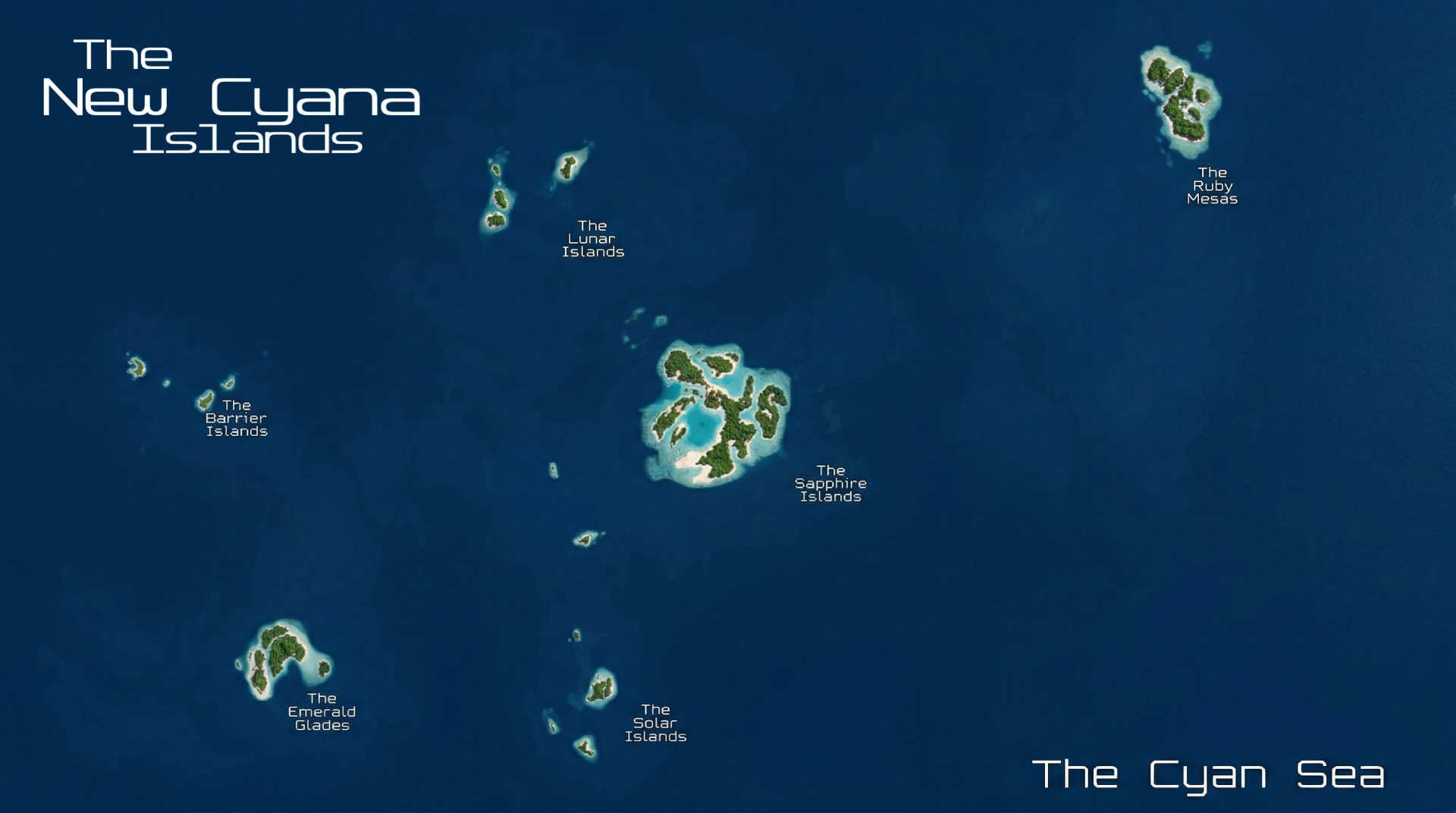
The relationship between the three is not merely historical but structural. Elder Cyana’s collapse created the shallow banks that allowed Old Cyana to flourish. Old Cyana’s erosion formed the sediment beds that now anchor New Cyana’s reef systems. Each generation stands literally upon the bones of the last.
Culturally, the continuity mirrors the geology. Oral traditions among local tribal councils speak of “Three Suns” or “Three Crowns,” describing a land that was once vast, then broken, then refined. Archaeological evidence supports layered occupation across at least two major migration waves. Megalithic fragments found on New Cyana align compositionally with stone quarried in the now-submerged sectors of Old Cyana. The monuments being restored today are not isolated relics — they are fragments of a lineage stretching back to Elder Cyana’s vanished highlands.
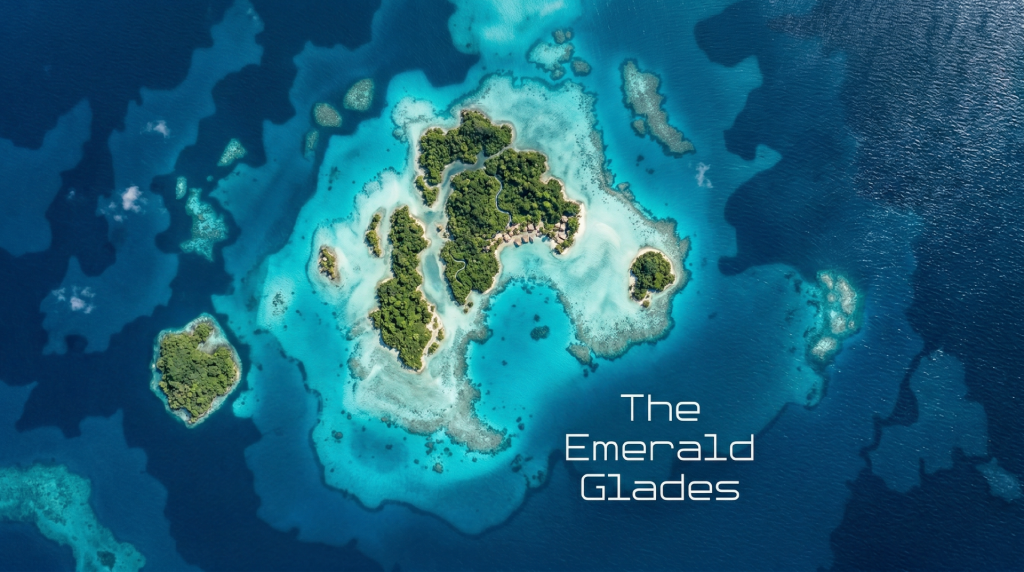
From orbit, the progression is unmistakable. The eastern drowned mass of Elder Cyana. The broad, partially submerged arcs of Old Cyana. The concentrated brilliance of New Cyana at the tectonic crown. A geological inheritance rendered in gradients of turquoise and deep ocean blue.