This case starts with something most artists don’t like admitting: loss.
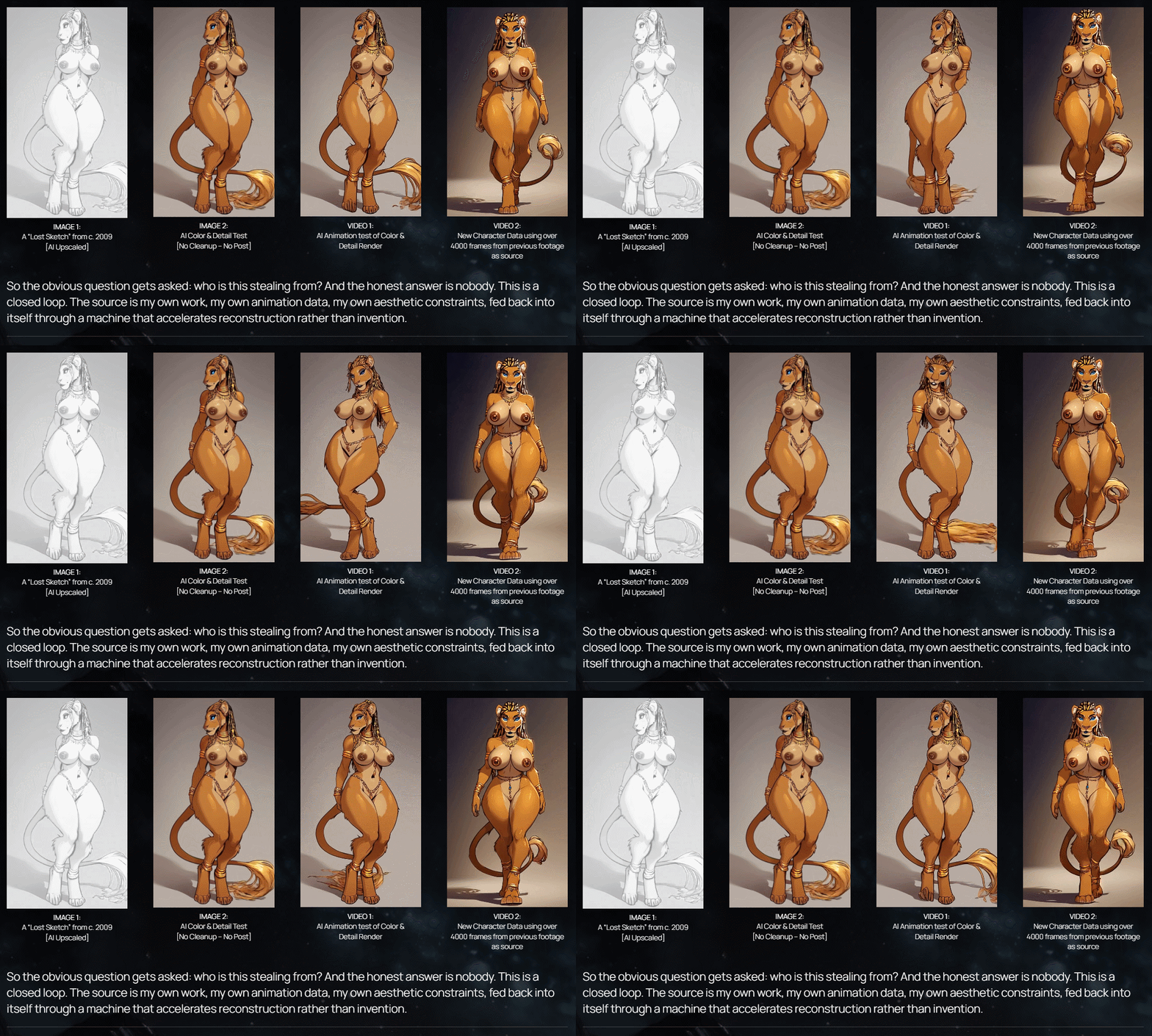
IMAGE 1: A “Lost Sketch” from c. 2009 [AI Upscaled]
Image 1 is a character that only survives as a low-resolution digital scan. The original drawing is gone. I don’t know where it went, and I probably threw it out around the time it was scanned, when it was already a decade old. That wasn’t unusual. I lost a lot of sketches over the years. Paper degrades, folders disappear, life moves on. What matters is that the scan is now the only remaining anchor tying that character to reality. Without it, the character would simply not exist anymore.
IMAGE 2: AI Color & Detail Test [No Cleanup – No Post]
Image 2 jumps forward to the present and flips the usual AI narrative on its head. This wasn’t about “letting the machine finish the art.” It was a stress test: how low-res could I go and still recover something recognizably mine? The answer was uncomfortably low. Flat base color, Flash-era shading logic, and eyes that sit in that slightly uncanny middle space my work has always had—probably a side effect of years inside Flash rather than any intentional stylistic choice. “Liminal” isn’t quite the right word, but close enough to get the point across. The takeaway here is that style isn’t stored in pixel density; it’s encoded in decisions, habits, and visual shortcuts learned over decades.
Video 1 pushes that idea into motion. This is the first test of taking an augmented sketch and making it move, using unreleased animation tests from years ago, in-game motion data, and custom renders done at 48 and 60 fps specifically because 24 fps just doesn’t hold up anymore. There’s nothing sacred about 24 fps—it was a technical compromise that got mythologized. Once you remove that assumption, everything looks cleaner, more responsive, and more in line with how people actually perceive motion today. This isn’t AI replacing animation skill; it’s animation knowledge being reused aggressively.
Video 2 is where people usually start getting loud. A fully AI-constructed walking model, derived entirely from the same sketch-to-AI-to-video pipeline you just watched. No external characters, no stylistic borrowing, no secret sauce lifted from someone else’s IP.
IMAGE 1: A “Lost Sketch” from c. 2009 [AI Upscaled]
IMAGE 2: AI Color & Detail Test [No Cleanup – No Post]
VIDEO 1: AI Animation test of Color & Detail Render
VIDEO 2: New Character Data using over 4000 frames from previous footage as source
So the obvious question gets asked: who is this stealing from? And the honest answer is nobody. This is a closed loop. The source is my own work, my own animation data, my own aesthetic constraints, fed back into itself through a machine that accelerates reconstruction rather than invention.
That’s the part that gets missed when people throw around words like “slop.” What’s actually happening here is time compression. This is about clawing back years that were burned dealing with unreliable collaborators, endless cleanup passes, and human bottlenecks that had nothing to do with creativity and everything to do with logistics, ego, or self-destruction. For someone who’s spent decades learning animation the hard way, being told this is lazy or unethical doesn’t land as critique—it lands as ignorance. The machine isn’t replacing craft here. It’s finally respecting it.
Crow has often noted that the period just before Flash began to lose institutional support in the early 2010s marked a peak of creative velocity that, until very recently has never come close to having been cleanly replicated since.
That window produced an unusual density of experimentation: systems half-built, worlds sketched in motion, mechanics tested not for market fitness but for mythic viability. It was an era when instability was tolerated because the tools encouraged risk, iteration, and idiosyncrasy. The collapse of that ecosystem was not gradual or organic; it was abrupt, external, and absolute, enforced by platform decree rather than creative exhaustion. The result was not merely the loss of a runtime, but the burial of thousands of living projects mid-gesture, entombed not by failure but by incompatibility.
What followed was not silence, but attrition.
Years of attempted restarts, partial revivals, and fractured collaborations marked a long interregnum in which the ambition remained intact while the infrastructure did not. Stable help was rare, continuity rarer still, and each revival attempt required translating old intent into new tools that never quite fit.
This period left behind a sedimentary record of abandoned builds and orphaned files—ideas that never died, but could not move forward. A stretch of time where the means to continue simply did not exist at scale for independent creators working outside institutional pipelines. With the arrival of AI-assisted tooling, that dead zone has ended. The archives are no longer inert.
Files once considered obsolete are now being examined, parsed, and harvested for lore, structure, and intent, revealing a surprisingly linear throughline beneath the fragmentation.
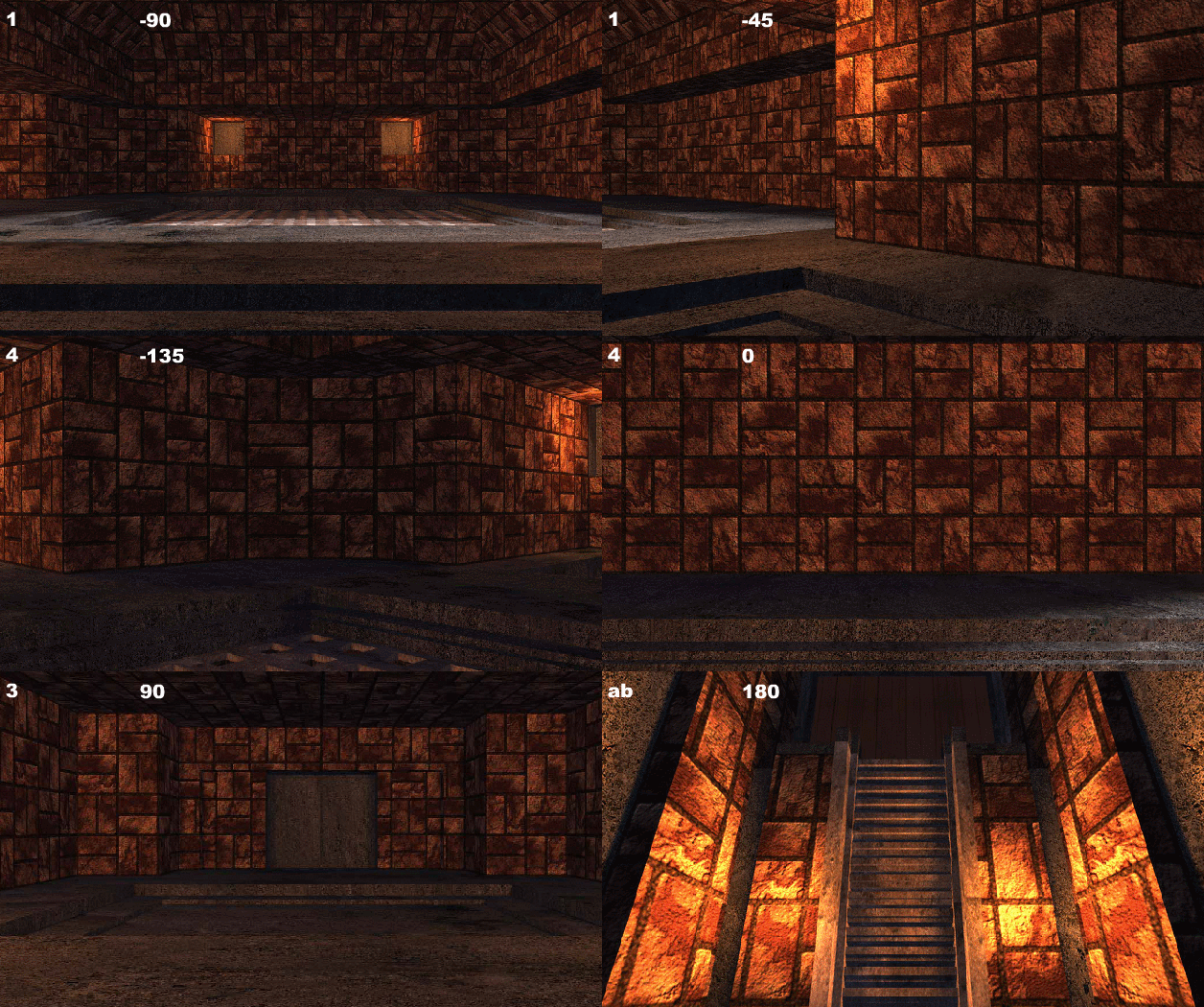
Fully Navigable 3d Space within a dungeon – Dungeon X c2012 – Would eventually become Warrior Class [Flash Prototype]
During this process, artifacts have surfaced—design fragments, conceptual stubs, narrative kernels—that will be shared moving forward to document the actual developmental arc of the series. These materials trace a clear line beginning in 2013, itself already a decade removed from the project’s first conception around 2003, demonstrating that what appeared to be discontinuity was, in fact, compression.
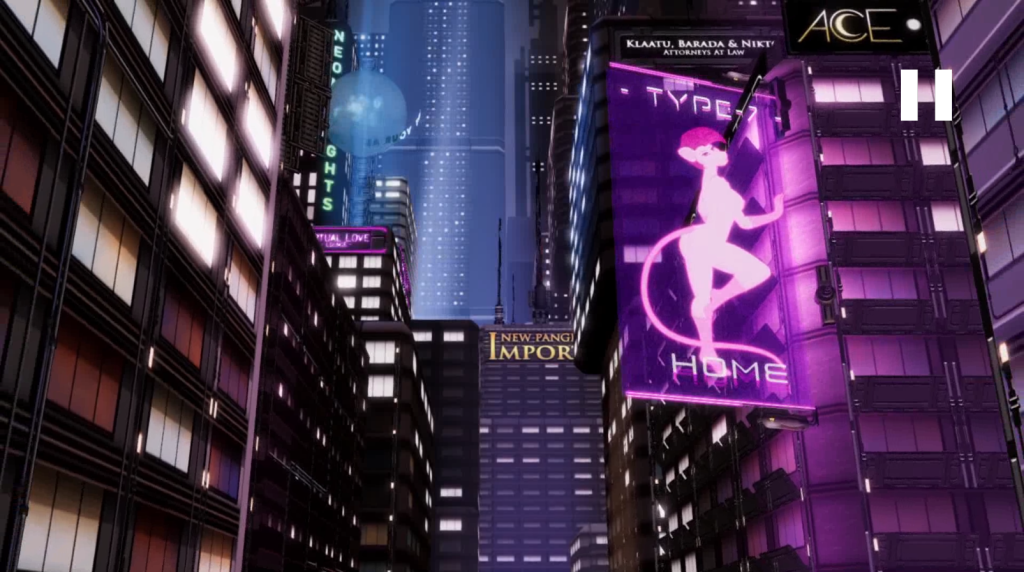
Virtual Love began as a groundbreaking project in the waning days of Flash, only to be abruptly stalled when the platform was retired—halting years of effort for us and countless creators.
Now, combining legacy experience with modern tools like Unity and AI, we’re back on track and closer than ever to realizing the original vision. Video production is already underway, with dozens more in active planning.
Our focus is on delivering curated, long-form scenes designed for both seamless video playback and future integration into custom apps and immersive, interactive environments.
Expect regular updates as new content goes live and the platform expands—this time with the momentum to last.
The erosion of myth has been a long, visible process, and the disconnect some readers feel between Crow’s current workflow and what they remember from his Flash and Newgrounds era is real. This journal exists to address that plainly:
Crow’s work was never meant to terminate at small browser games. Even in the early 2000s, when High Tail Hall first took shape, the trajectory was already pointed toward something larger: persistent worlds, coherent mythic structures, and settings with memory and consequence. What never changed was the core principle that these worlds must remain enjoyable, usable, and rewarding for the communities that inhabit them over time.
Modern myth was not in its present condition in the early 2000s:
There was still coherence, restraint, and an understanding of myth as structure rather than branding. Crow’s position is blunt: the Star Wars cycle he valued peaked roughly between 1997 and 2005 and never recovered. This is not an internet-hot take or nostalgia reflex.
It is the judgment of someone who has watched enough cultural cycles rise, hollow out, and collapse to recognize terminal decline. There is a real failure threshold—once audience rejection crosses a certain point, a canon no longer heals. It fossilizes. At that stage, revival becomes simulation, not restoration.
This pattern has repeated across modern franchises. Star Wars persists on life support, animated primarily by reputation and memory. Star Trek survives as a self-parody, reproducing surface aesthetics while abandoning its internal logic.
Lord of the Rings drifts without a clear audience or identity. These outcomes were not accidents of time. They were the predictable result of corporate systems that treat myth as an extractable resource rather than a living structure. Myth cannot survive that treatment indefinitely.
Crow is explicit about who he is and where this work comes from:
He emerged from the Flash-era internet as a cyberspace pornographer, producing small, sharp adult games for a narrow but dedicated audience. He does not distance himself from that history. He rejects the premise that this background disqualifies him from mythic work.
Historically, myth has always been carried forward by figures outside polite institutions: outsiders, degenerates, mercenaries, poets, and people deemed unfit by gatekeepers. Institutional consensus has rarely been the source of durable myth.
The ambition to operate at a mythic scale did not appear recently. What appeared recently was the technology to support it. The acceleration some readers have noticed is not impulsive; it is deferred momentum. Decades of abandoned plans, constrained ideas, and unrealized structures are now viable. That includes megastructures, planetary-scale conflict, ancient feuds, long arcs, and settings that remember what happened to them.
It also includes sex and adult content integrated into the myth rather than segregated as an embarrassment. Crow’s position is that these elements were never incompatible; only modern corporate myth pretends they are.
This is not resignation. It is escalation. The mishandling of modern mythic franchises is not abstract theory; it has unfolded in real time:
The end state is consistent: myth reduced to product, product reduced to poor product, and poor product reduced to infantilized sludge. When the work is dismissed as “AI slop,” the accusation fails because it assumes a landscape where comparable projects exist at this scale, with this level of continuity and risk. They largely do not. The absence is precisely why this work exists.
Crow’s argument regarding Star Wars is specific. It was never merely “for children” in the way it is now defended. It was a family myth that made room for children without evacuating darkness, loss, brutality, or consequence. Limbs were severed. Worlds were destroyed. Death mattered. Those elements were not incidental; they were foundational. When they were stripped away, the myth lost its gravity. That loss is not trivial, and it is not recoverable through branding alone.
Crow accepts the possibility of failure—total, public, irreversible failure. He considers that preferable to waiting for corporations with vastly greater resources to act responsibly and choosing not to, again and again.
The projects moving forward are adult by design. They are mythic by intent. They are allowed to be dangerous, sexual, grand, and uncomfortable. They are not built to satisfy quarterly risk assessments. No permission is required to make them, and no credible authority exists to prevent them.
This journal exists to clarify that position. What follows is not reactionary content, trend-chasing, or nostalgia mining. It is the continuation of a long trajectory that finally has the tools to support its own weight. Crow did not arrive here accidentally. He arrived here because he understood that this was the only direction left that still made sense.
To be clear, this is not an attempt to compete with Star Wars on its own terms.Crow’s intent is to operate in a space that corporate franchises can no longer access, let alone control:
What is being built here is a line of premium works—adult, uncompromised, and structurally coherent—that institutions bound to risk committees, brand management, and shareholder appeasement are fundamentally incapable of producing. That is not bravado; it is a simple consequence of how those systems function.
Crow’s position is that creators and audiences alike deserve better than endless myth recycling in service of entities that have neither the courage nor the capacity to protect what they own. The point is not to eclipse the great sci-fi myths of the past. It may never do that, and it does not need to. What matters is that the work retains its integrity—myth built with intent, continuity, and consequence rather than diluted into focus-tested sludge.
This is not about replacement. It is about refusal. Refusal to submit to creative servitude, refusal to hollow out meaning for scale, and refusal to pretend that degraded myth is the best we can do. If nothing else, these works will stand as proof that coherence, adulthood, and conviction are still possible. Crow understands the limits. He also understands the obligation. Integrity, at this stage, is not optional—it is the minimum.
The retro projects are not just legacy obligations; they actively support the broader creative process. As they are revisited and stabilized, the combined lore of the classic settings is being clarified, expanded, and documented in a more permanent form. Over the coming months, that material will be fleshed out directly on the website, giving long-fragmented ideas a coherent home rather than leaving them scattered across dead platforms and half-remembered builds.
Moving forward, the output will be broader and more consistent in form, even if the releases themselves remain staggered. You should expect a steady flow of general content:
development journals, workflow updates, and deeper lore entries alongside video material, audio erotica, and the next generation of interactive experiences. This is not a pivot away from games, but an expansion of how the worlds are communicated and inhabited while those games are being brought properly up to speed.
Many of you have supported this work for a long time. That support is remembered, and it matters. The patience and dedication shown over the years are not being taken for granted, and you will see the results of that commitment as the upcoming lineup reaches demo-ready form and begins releasing in a more tangible way.
For those who are newer to the project, the recent increase in released material is intentional and expected to continue. As tooling improves, workflows stabilize, and external platform costs become more predictable and manageable, Crow expects both output and cadence to increase. This is the natural result of foundational systems finally locking into place after a long period of instability.
During this phase of active development and structural reinforcement, support through Patreon directly helps keep HTH Studios moving forward:
It allows more frequent updates, clearer communication, and a steady flow of material without forcing premature changes onto the “classic IP’s”.
Vaultus, in particular, will see more regular updates, serving as the space where stylistically experimental work can live and evolve without compromising the integrity of the legacy settings.
Thank you for joining us. We hope you have found this more “direct” format of behind the scenes dev-journal informative, and we will have more for you soon. take care, and as always, thank yu for playing.
This entry into the vaultus archives has been made possible by the collaborative efforts of both man and machine. AI was utilized specifically to assemble and compile vast amounts of notes and data as part of the editorial process over seen and posted in it’s current form
Crow is opening the inner sanctum for a closer look—not just at the finished product, but at the thinking, the missteps, and the method behind the madness.
Title:Empire [Redux] Released: 2025 Format: Digital Production Company: HTH Studios Producer: Crowchild Software: SUNO
Intro [REDUX]Force of Empire [NEW]Diva [REDUX]Midnight Empire [REDUX]Grinder [REDUX]Grinder II [REDUX]Infinite Night [NEW]Pulse of Empire [REDUX]Sunrise [REDUX]
It’s built as an open-source experiment, meant to grow, adapt, and eventually invite collaboration once the foundation is solid. What you’re seeing on this page is the entry point: four concept albums released through SUNO that establish the tone, atmosphere, and narrative logic of this version of the Florida Project.
The Prelude, The Florida Project, sets the mood before the city exists—raw land, ambition, and the serious industrial mindset required to carve a metropolis out of central Florida’s wilderness. It’s the prologue to everything that follows.
Before the towers, before the monorails, before the skyline had a shape, there was the raw expanse of central Florida and one man insisting a city of tomorrow could be carved out of that wilderness.
The sound of a metropolis that has survived its proving years and now knows it will endure.
Taken together, the four albums aren’t just soundtrack pieces—they’re the audible blueprint of the setting itself.
EPCOT City begins with music because it’s the cleanest, fastest way to communicate the kind of world this is meant to be: corporate-futurist, ambitious, grounded in 1960s–1990s technical optimism, and serious about exploring what Walt actually meant when he said the city would “never be completed.”
That’s the doorway. The larger experiment grows from here—documents, timelines, maps, systems, corporate entities, and eventually an openly collaborative framework where others can build within the same fictional city.


![Blast From The Past [2013]](https://hthstudios.com/website/wp-content/uploads/2026/01/GIF-10-1-2025-2-24-43-AM.gif)




![EMPIRE [REDUX]](https://hthstudios.com/website/wp-content/uploads/2025/12/Empire.2025.webp)


